Android applications rarely remain unchanged. Developers introduce new features, adjust subscription plans, revise permissions, fix technical problems, and discontinue older versions. An app description that was accurate several months ago may no longer reflect what a user will find today.
For APKProTech.com, producing useful Android content therefore involves more than collecting a few features and turning them into a summary. Each article needs a defined purpose, dependable supporting information, appropriate context, and an editorial review that separates confirmed facts from interpretation.
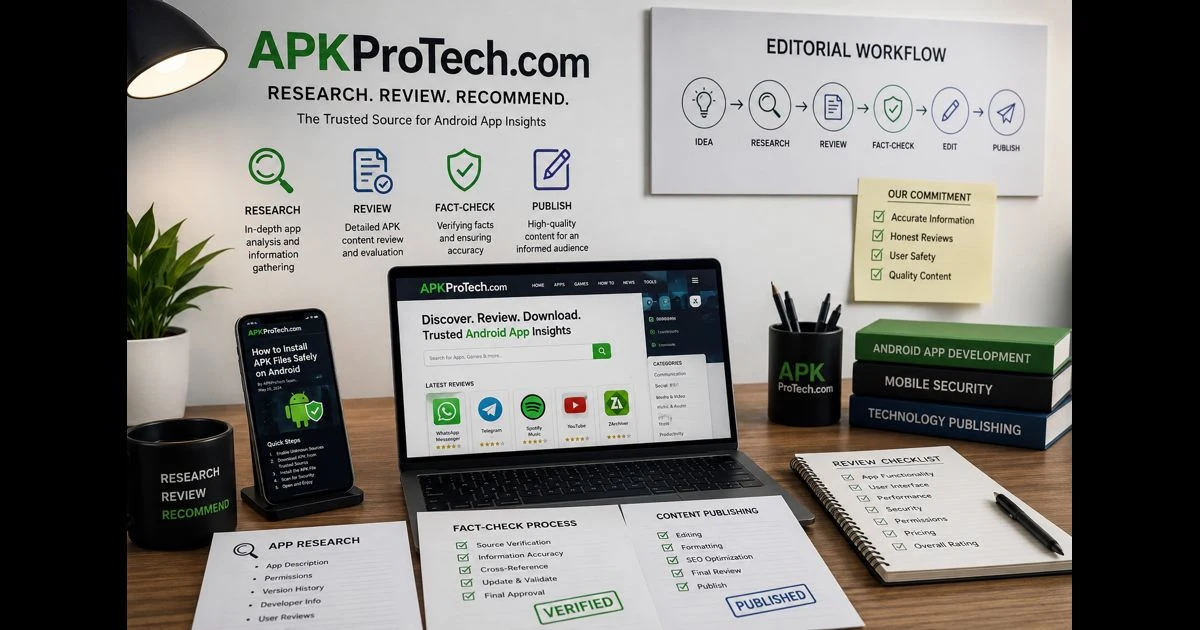
The process described below explains how APKProTech.com approaches Android app research, evaluates available information, handles uncertain details, and prepares content for publication.
Defining the Article Before Beginning Research
Research becomes unfocused when an article tries to answer every possible question about an application. The first step is to establish what the page should help a reader understand.
An article may focus on an app’s primary purpose, important features, compatibility, pricing model, privacy considerations, setup process, or suitability for a particular type of user. Comparisons and troubleshooting guides require different evidence and should not be combined with a general app overview unless they contribute directly to the subject.
Before writing begins, the topic is reviewed through several questions:
- What is the central subject of the article?
- Which information would materially help the reader?
- Which claims will require verification?
- Are any details likely to vary by device, region, account, or app version?
- Does the topic add something distinct to the existing content library?
This initial scope prevents the finished article from becoming a collection of loosely connected facts.
Building Research Around Reliable Information
Not every available source carries equal weight. A copied app description, an outdated review, and current developer documentation should not be treated as equally dependable.
Research normally begins with first-party information, such as the app’s current store listing, developer documentation, release notes, support material, and published policies. These sources are most useful for confirming details such as the developer’s identity, stated features, pricing structure, system requirements, and recent changes.
However, first-party descriptions are often written to promote a product. They establish what the developer claims, but they do not automatically prove that every feature performs equally well for every user. Editorial language should preserve that distinction.
Secondary material may provide additional context, particularly when an article discusses broader Android concepts or known changes. Any supporting information is checked for relevance, publication date, and consistency before it influences the article.
Recording Details That Can Change
Android content can become outdated quickly if version-sensitive details are presented without context. During research, APKProTech.com pays particular attention to information that may change after publication.
Depending on the article, the research record may include:
- App name and identified developer or publisher
- Current availability and supported regions
- Android version or device requirements
- Latest version information available during research
- Stated features and recent release changes
- Free, paid, subscription, advertising, or in-app purchase model
- Account and internet requirements
- Permissions and access requested by the application
- Known limitations disclosed by the developer
- Date on which important details were checked
Recording these details does not mean every item must appear in the final article. It gives the writer enough context to avoid outdated or misleading statements.
Confirming an App’s Identity
App names are not always unique. Similar names, unofficial copies, regional editions, and older listings can create confusion about which product an article is discussing.
Before evaluating features, the app’s identity should be established through the listed developer, package information where relevant, platform availability, and recognizable product details. If the identity cannot be confirmed confidently, the article should not present uncertain information as fact.
This step is especially important when an unfamiliar app name appears on several unrelated websites. Repetition across different pages does not make a claim reliable. The underlying application and publisher still need to be identified.
Evaluating Feature Claims Carefully
A feature should not be described as available simply because an old article or promotional page mentions it. Each material feature is checked against current information whenever possible.
The review also considers the conditions attached to a feature. Some tools may only be available through a paid plan, in selected countries, on newer Android versions, or after creating an account. Others may depend on a separate device, service, or internet connection.
These conditions matter because a technically accurate but incomplete statement can still mislead a reader. Instead of saying that an app “includes unlimited cloud storage,” for example, the article should clarify if that storage is restricted to a particular subscription tier.
Using Hands-On Review Responsibly
Direct use can reveal interface behavior, setup requirements, navigation patterns, and practical limitations that are not obvious from published documentation. Where hands-on access is practical, observations may be recorded on the device and app version used during the review.
Testing one configuration does not prove that every user will have the same experience. Performance may vary according to the device, Android version, network quality, region, account type, and later software updates.
For this reason, hands-on observations should be presented with appropriate context. A review should not claim universal performance from a limited test.
When an app cannot be tested directly, the article should rely on documented information and should not imply that features were personally evaluated. Honest limits strengthen an article more than an unsupported claim of comprehensive testing.
Reviewing Permissions and Privacy Without Making Guarantees
Permissions can help readers understand what parts of a device an application may access. Their meaning must still be considered in relation to the app’s function. A navigation app may reasonably need location access, while a communication tool may request microphone or contact permissions for specific features.
A permission alone does not prove that an app is harmful. Likewise, the absence of an obviously unusual permission does not establish that an app is completely safe.
APKProTech.com content should explain relevant privacy or permission considerations without issuing guarantees that cannot be substantiated. Absolute phrases such as “100% secure,” “completely risk-free,” or “guaranteed malware-free” should not appear unless the site possesses current, documented evidence capable of supporting such a statement.
Readers should instead receive practical context about what an app requests, why that access may be needed, and which settings they can review before using it.
Separating Facts, Claims, and Editorial Assessment
Clear app content distinguishes between three different kinds of information:
- A confirmed fact supported by current documentation
- A claim made by the application’s developer
- An editorial observation or assessment
These categories should not be blended together. If a developer describes an app as the “fastest” in its category, the article should not repeat that description as an established fact without suitable comparative evidence.
Similarly, subjective descriptions such as intuitive, powerful, seamless, or best should be supported by meaningful explanation. Readers benefit more from knowing that a tool groups its controls into three clearly labeled sections than from being told that it has an “amazing interface.”
This distinction is part of the site’s broader editorial standards for Android content, which prioritize clarity and balanced presentation over promotional language.
Turning Research Into a Useful Article
A research file can contain more information than a reader needs. The writing stage determines which details support the article’s purpose and how they should be presented.
A well-developed app guide normally helps readers understand:
- What the application is designed to do
- Who may find it useful
- Which features define its experience
- What is required to begin using it
- Whether important functions require payment
- Which limitations deserve consideration
- Which details may change across versions or devices
The exact structure should follow the topic rather than a fixed template. A privacy guide, app comparison, feature overview, and troubleshooting article should not all use identical sections.
APKProTech.com’s wider coverage of Android app guides, APK knowledge, and technology provides broader context, while each individual publication remains focused on its own subject.
Avoiding Copied and Promotional Language
Store descriptions can provide useful factual information, but they should not be republished as editorial content. Promotional descriptions often contain superlatives, repeated selling points, and claims that lack important conditions.
The writer’s responsibility is to understand the available information and explain it independently. Rewording every sentence with synonyms is not genuine originality. The final article should have its own structure, analysis, emphasis, and language.
The same rule applies to reviews published elsewhere. Other opinions may help identify issues that require investigation, but they should not be copied or converted into unsupported conclusions.
The Prepublication Review
Before an article is published, it should pass more than a basic grammar check. APKProTech.com’s review process considers factual accuracy, editorial quality, and the complete reading experience.
Factual Review
Names, features, dates, compatibility statements, pricing conditions, and version-sensitive details are checked against the research record. Unsupported claims are removed, qualified, or investigated further.
Editorial Review
The article is examined for repetition, vague wording, exaggerated language, unnecessary technical terminology, and sections that do not advance the subject. Headings should accurately represent the information beneath them.
Link and Presentation Review
Internal links are included only when another page genuinely expands the reader’s understanding. Images, captions, headings, and other page elements are checked so they do not create claims that the article itself cannot support.
If a material fact remains uncertain, publication may be delayed or the limitation may be stated openly rather than hidden behind confident wording.
Updating Published Content
Publication is not the end of an Android article’s useful life. Meaningful changes may require an existing page to be reviewed again.
An update may be appropriate when:
- The application receives a substantial redesign
- A major feature is added or removed
- Pricing or subscription access changes
- Compatibility requirements are revised
- The app changes its name or ownership
- Previously accurate instructions no longer match the interface
- New information materially changes the article’s conclusions
Updates should improve the substance of the page. Changing a date without reviewing the content does not make an article current.
Small wording corrections may not require a formal notice. When a significant factual error or material change is corrected, acknowledging the update can help readers understand why the page differs from an earlier version.
Being Clear About Limitations
No review can reproduce every possible Android environment. Thousands of device models, customized manufacturer interfaces, regional restrictions, account types, and software versions can affect how an application behaves.
Responsible content acknowledges those limitations where they matter. It does not turn a single successful installation into proof of universal compatibility, and it does not treat one technical problem as evidence that an app fails for everyone.
This measured approach may appear less dramatic than absolute praise or criticism, but it gives readers a more accurate basis for evaluating the application themselves.
What Readers Should Expect
APKProTech.com aims to publish Android content that is understandable, appropriately researched, and honest about what can and cannot be confirmed. Readers should be able to distinguish documented details from developer claims and editorial observations.
The objective is not to recommend every app or present each new feature as essential. It is to explain the subject well enough for readers to make their own decisions based on their needs, devices, and comfort with the relevant requirements.
Final Thoughts
Reliable Android app content is produced through a series of connected decisions: defining the subject, selecting dependable information, checking changeable details, reviewing important claims, explaining limitations, and revisiting the page when the underlying application changes.
For APKProTech.com, this process provides a practical foundation for publishing content without relying on copied descriptions, unsupported guarantees, or promotional exaggeration. A careful research and review method cannot prevent Android technology from changing, but it can ensure that each article is prepared responsibly and remains genuinely useful for readers.







Leave a Reply